
Over-dispersed Poisson bootstrap
Resampling of Pearson residuals from an over-dispersed Poisson model fitted to the triangle, producing the full reserve distribution rather than just its standard deviation.
England and Verrall, 1999, Insurance: Mathematics and Economics, on the prediction error of chain ladder. Mack (ASTIN Bulletin, 1993) returns a mean and a standard deviation; regulatory capital, however, is read at a percentile. The ODP bootstrap closes that gap. You fit an over-dispersed Poisson model to the incremental triangle whose central estimates coincide with chain ladder, extract the Pearson residuals, resample them with replacement to build thousands of pseudo-triangles, rerun chain ladder on each, then add to every simulated reserve a process error drawn from a gamma distribution. Out comes a histogram of reserves, where the 99.5th percentile is read. Two limits. Residuals are assumed identically distributed, which is false when inflation accelerates. And a triangle sometimes holds only fifty-five points: the bootstrap cannot invent tail that no cell ever observed.
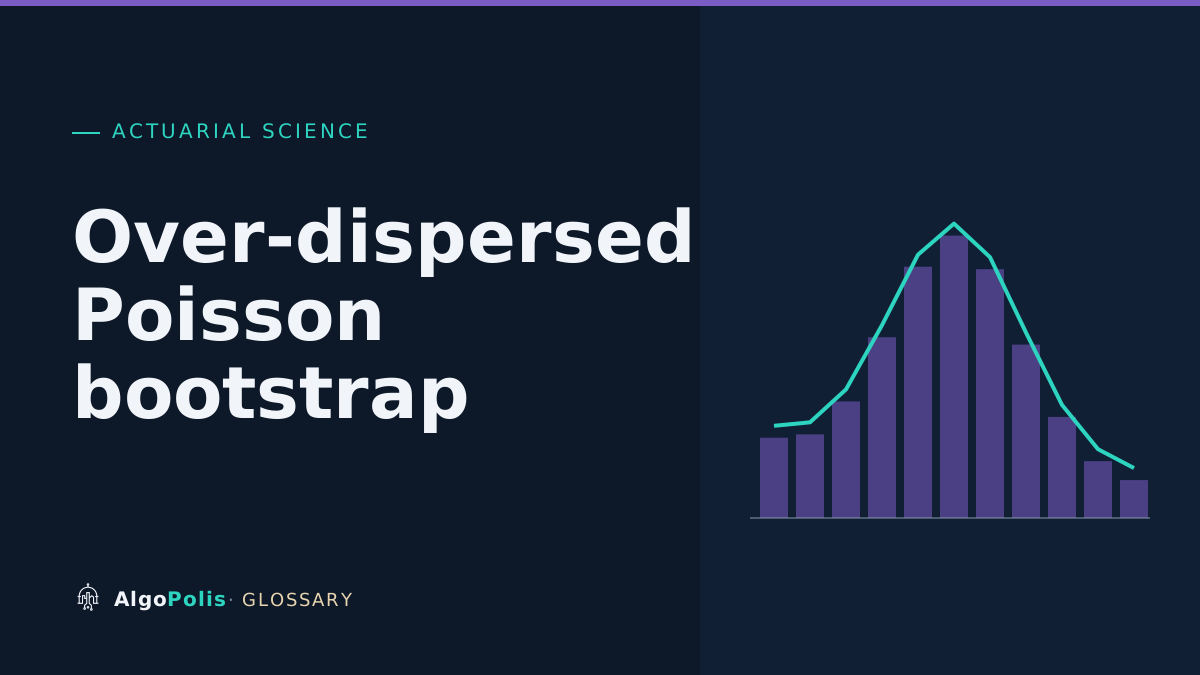
Property book of a regional insurer as of June 30, 2026, 10,000 simulations. Central reserve 41.3M EUR, bootstrap mean 41.5M EUR, standard deviation 4.8M EUR, 75th percentile 44.6M EUR, 99.5th percentile 56.1M EUR. The gap between the 99.5th percentile and the mean, 14.6M EUR, is the reserve risk capital charge before diversification.
Follow the research
One letter a week. First, the week's underwriting note, when one is published: a dated, argued decision, signed by Paul Bernardski. Then what the observatory published on cyber risk, political risk and insurance. No account, no tracking.
No spam, one-click unsubscribe, no data ever sold.