
Wind production index cover
Cover that pays a wind farm owner when a wind index, converted into theoretical output through the turbines' power curve, falls below a threshold over the period (month, quarter, year).
Wind production index cover is insurance that pays a wind farm owner when a wind index, converted into theoretical output through the turbines' power curve, falls below a threshold over the period. A 100 MW wind farm financed on eighteen years of debt lives on one assumption, the P50 energy yield from the wind resource assessment. One low-wind year and the debt service coverage ratio (DSCR) drops below the covenant. Wind production index cover pays that volume shortfall without any turbine breaking down. The index starts from wind speeds, measured at the site met mast or, more often, taken from a reanalysis. The usual ones are ERA5, from the European Centre for Medium-Range Weather Forecasts (ECMWF), and MERRA-2, from NASA. They give a long, consistent series and a source neither party controls. Hourly speeds run through the turbines' power curve, get summed over the period and are compared with a strike, say 90% of P50. Below it, the contract pays an agreed price per missing megawatt-hour, up to a limit. In 2021 wind speeds over parts of northwestern Europe were among the lowest in four decades, according to Copernicus. Ørsted put the hit at about DKK 2.5 billion over nine months against 2020: volume risk is anything but theoretical. The structure looks like a weather derivative, and the choice between policy and derivative comes down to insurable interest, hedge accounting and counterparty. Basis risk lives between the index and the revenue meter: turbine availability, wake losses, curtailment ordered by the grid operator, icing, and the gap between a thirty-kilometer reanalysis grid cell and the site's terrain. A turbine failure belongs to machinery breakdown and business interruption cover; the index does not see it, by design. Power price stays outside the contract unless the structure combines volume and price. Those show up next to baseload power purchase agreements (PPAs). Under those, the owner has to deliver megawatt-hours it did not generate and buy them back on the market, often at a high price precisely when the wind is down everywhere.
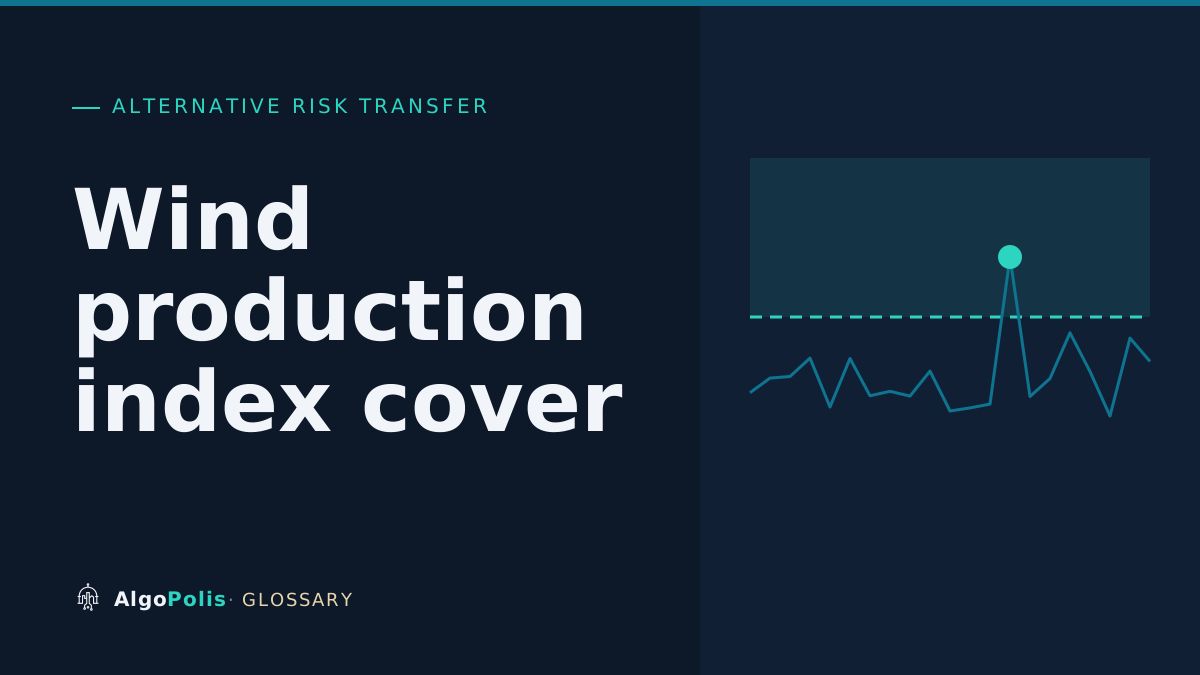
Textbook case, made-up numbers: a 100 MW wind farm has a P50 of 300 GWh a year. The contract pays 40 euros per missing MWh below a 270 GWh strike, computed from ERA5 and the declared power curve, with a 2 million euro limit. The index comes in at 255 GWh: 15,000 MWh short, 600,000 euros paid. The meter reads 240 GWh, because grid curtailment and turbines offline took the rest. Those 15 GWh stay with the owner, or with its machinery breakdown cover for the share that falls under it.
wind index insurance, wind volume hedge, wind production cover, low wind insurance, wind proxy hedge
Follow the research
One letter a week. First, the week's underwriting note, when one is published: a dated, argued decision, signed by Paul Bernardski. Then what the observatory published on cyber risk, political risk and insurance. No account, no tracking.
No spam, one-click unsubscribe, no data ever sold.