
Claims reporting lag
The time between the occurrence of a claim and its notice to the insurer. Its distribution drives pure IBNR, and it ranges from a few days in motor to several decades for asbestos.
In November 2018 Marriott announced that the Starwood reservation database had been compromised, and the investigation traced the intrusion back to 2014. Four years separated the triggering event from the first trace in a claim file. Reporting lag measures that gap, from occurrence to notice, and its distribution sets the size of pure IBNR. In motor, most claims arrive within the month. In asbestos, mesothelioma commonly appears thirty or forty years after exposure, so policies written in the 1960s received claims well after the French ban of January 1, 1997. Medical malpractice sits in between, with injuries that surface at consolidation or when the child comes of age. Cyber has its own version: the attacker's dwell time sets the lag, and it is counted in months. The actuary reads the distribution on a triangle of counts rather than amounts, sorting claims by accident year and by reporting delay, and derives the share of still unknown claims at each age. The coverage trigger distorts it. A claims-made policy cuts off the tail, since only the date of the claim during the period counts. It pushes long-latency risk onto the extended reporting period or the next carrier; an occurrence policy keeps all of it. The distribution also shifts when the channel changes: online notice or a plaintiff lawyers' campaign pulls the curve forward, and a chain ladder on counts reads that gain in speed as a rise in frequency. Not to be confused with the contractual deadline the insured must meet to give notice of a claim, or with the settlement pattern, which starts once the file is open.
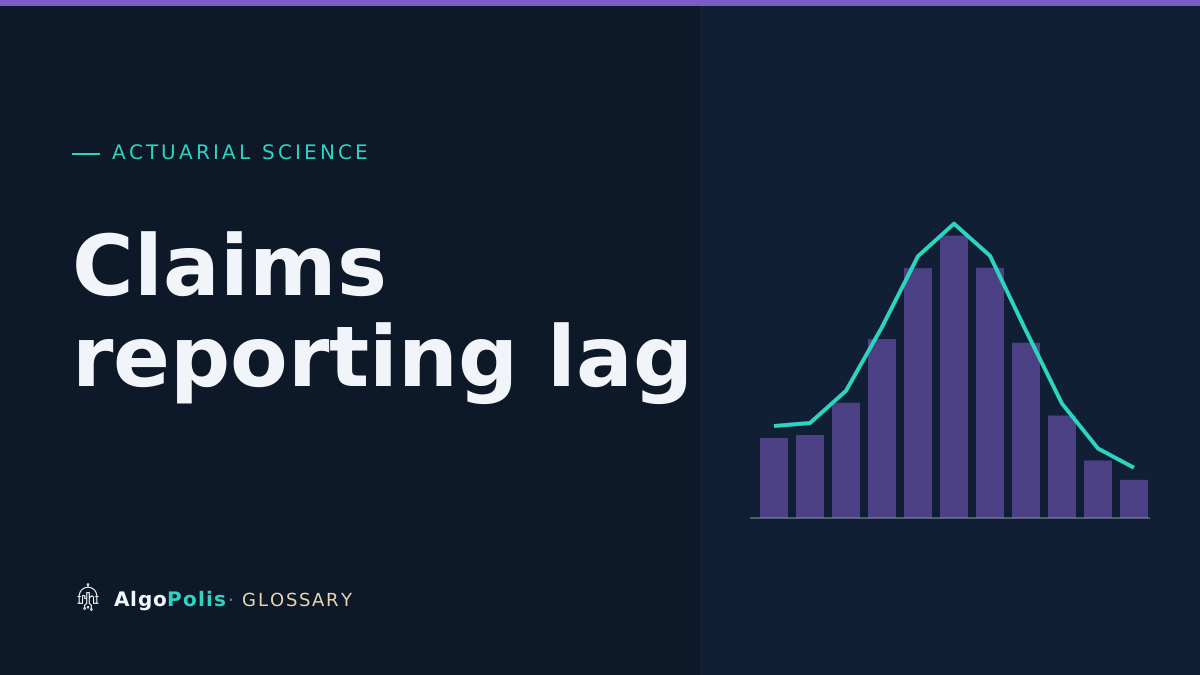
Constructed example: a general liability accident year should reach 1,000 claims at ultimate. 60% are reported in the first year, 25% in the second, 10% in the third, 5% afterward. At 12 months, 600 files are open and 400 are still unknown. At an average cost of 8,000 EUR, pure IBNR is 3.2 million EUR. If an online notice campaign lifts the first year to 70% without changing the total, the triangle shows 700 files. A chain ladder calibrated on 60% then concludes 1,167 claims, 167 too many and 1.3 million EUR of phantom losses.
reporting lag, report lag, reporting delay, notification lag
Follow the research
One letter a week. First, the week's underwriting note, when one is published: a dated, argued decision, signed by Paul Bernardski. Then what the observatory published on cyber risk, political risk and insurance. No account, no tracking.
No spam, one-click unsubscribe, no data ever sold.