
Life ILS
Insurance-linked securities that pass a risk on people to capital markets: extreme mortality, pandemic, longevity, or the future value of a block of life policies.
Life ILS (insurance-linked securities) are securities that pass a risk on people to capital markets: extreme mortality, pandemic, longevity, or the future value of a block of life policies. In June 2017 the World Bank placed 320 million dollars of pandemic bonds for its Pandemic Emergency Financing Facility, the PEF, in two classes. The trigger counted cases, deaths, the number of countries affected and the speed of spread. It also carried a waiting period of several weeks after the outbreak began. In April 2020 Covid-19 met every condition: the riskier class was wiped out, the other partly written down, and a little under 200 million went out, swaps included. The criticism was about speed, not the math. The PEF is the most visible deal in a quiet market. Life ILS start with extreme mortality. The bond tracks a population mortality index weighted by country, age and sex. Principal erodes once the index exceeds a multiple of its base, often somewhere between 105 and 120 percent. Longevity mostly moves through swaps, after the first longevity bonds struggled to find buyers in the mid 2000s. The rest of the volume is private and shows up in no cat bond statistic: embedded value securitizations, funding of redundant statutory reserves in the United States. A population index shields the investor from moral hazard. It leaves the cedent with basis risk, because its policyholders do not die the way the national population does. And the low correlation pitch hit its limit in March 2020, when the pandemic eating into principal was also taking equities down.
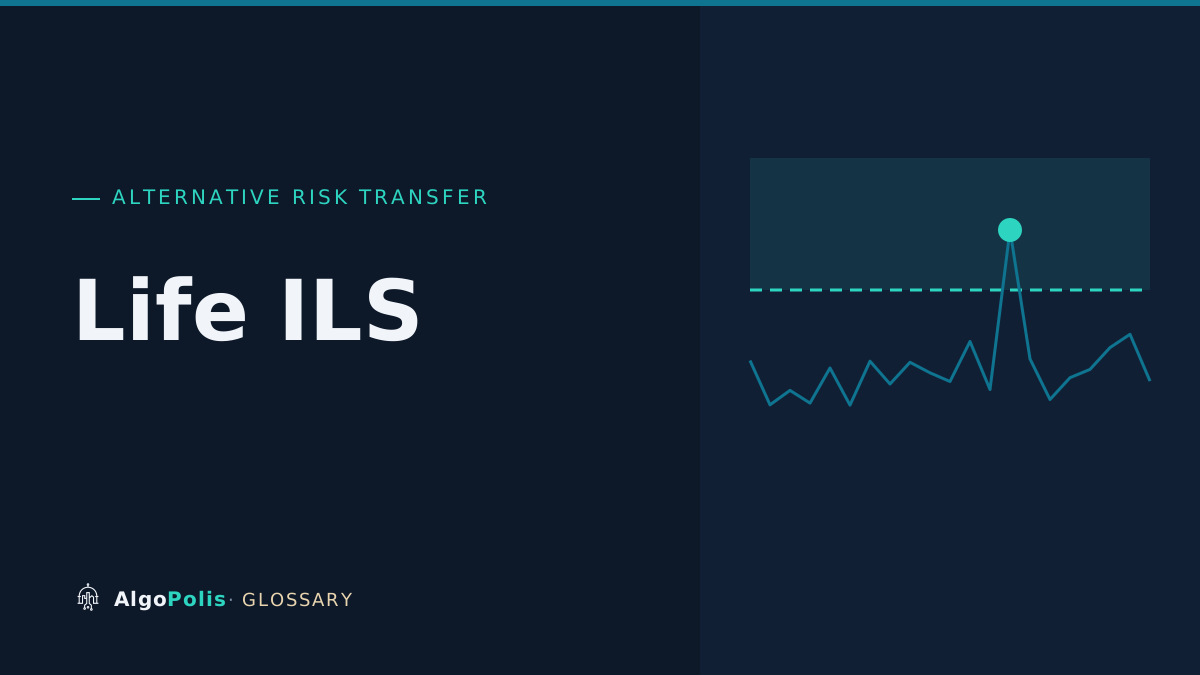
Textbook case, made-up figures: a 300 million dollar extreme mortality bond tracks an index weighted across three countries. Attachment sits at 110 percent of base mortality, exhaustion at 120 percent, with linear principal loss in between. In a year when the index reaches 114 percent, investors lose 40 percent of principal, or 120 million paid to the cedent, whatever the number of deaths in its own book.
life ILS, life insurance-linked securities, extreme mortality bond, pandemic bond, life securitization
Follow the research
One letter a week. First, the week's underwriting note, when one is published: a dated, argued decision, signed by Paul Bernardski. Then what the observatory published on cyber risk, political risk and insurance. No account, no tracking.
No spam, one-click unsubscribe, no data ever sold.