
1918 influenza pandemic
The 1918-1919 influenza pandemic, the deadliest of the modern era with tens of millions of deaths, which serves as the benchmark scenario for extreme mortality models, regulatory shocks and life catastrophe bonds.
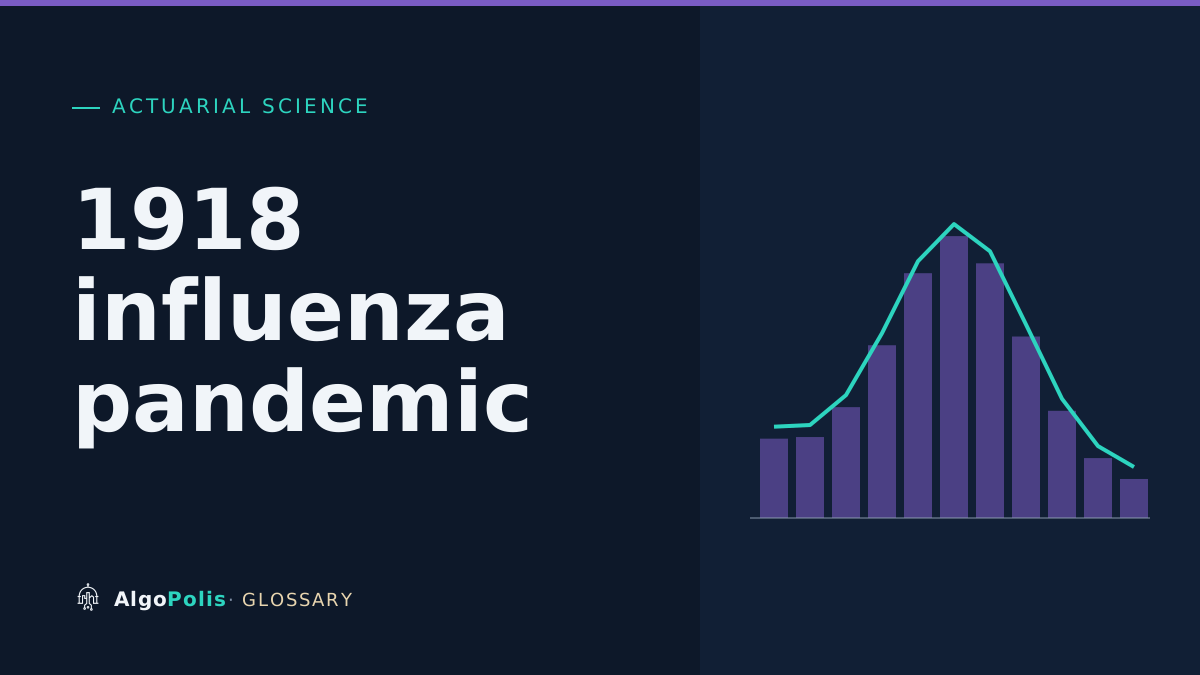
The Spanish flu is the 1918-1919 influenza A (H1N1) pandemic, and the anchor of everything life actuaries know about mortality shocks. Death toll estimates run from 20 to 100 million, with 50 million as the usual figure, out of a world population of about 1.8 billion. Three waves followed one another, the second, in the fall of 1918, being the deadliest. The feature that matters to an underwriter is the age curve. Instead of hitting mainly infants and the elderly, the virus killed young adults aged 20 to 40 in large numbers, that is, the population insured for death and credit life. US life insurers paid about $125 million in influenza claims in 1918, a sum that unbalanced several balance sheets. Modelers replay the scenario on today's population. An AIR study published in 2013 put the additional US life insurance loss alone at $15 to $28 billion. The Solvency II standard formula applies an instantaneous shock of 0.15 percentage points to one-year mortality rates, calibrated on a pandemic of this kind. Mortality catastrophe bonds, tied to population indices, make influenza the main component of their models. The caveat is antibiotics. Many 1918 deaths came from secondary bacterial infections that would be treated today, which leads some models to lower the transposed case fatality rate.
Textbook case: a credit life insurer covers 2 million lives, with an average outstanding balance of 150,000 euros and a base mortality of 1 per thousand. The standard formula shock of 1.5 per thousand adds 3,000 deaths in a year, or 450 million euros of extra claims. Replayed with the 1918 age curve, heavier among the 25 to 45 year olds who make up most of the book, the internal scenario rises to 700 million.
Spanish flu, 1918 flu pandemic, 1918 H1N1, 1918 pandemic scenario
Follow the research
One letter a week. First, the week's underwriting note, when one is published: a dated, argued decision, signed by Paul Bernardski. Then what the observatory published on cyber risk, political risk and insurance. No account, no tracking.
No spam, one-click unsubscribe, no data ever sold.