
Catastrophe reinsurance (Cat XL)
Non-proportional reinsurance treaty that protects a cedant against the accumulation of losses from a single catastrophic event beyond a given retention.
January 24, 2009: windstorm Klaus brings a French insurer's losses to 180 million under a program of 50 XS 50, 150 XS 100 and 250 XS 250. The first layer is exhausted, and 80 million of the second is used. Catastrophe reinsurance, known as Cat XL (Catastrophe Excess of Loss), is a non-proportional reinsurance treaty. It protects the cedant against the accumulation of losses from a single catastrophic event, such as an earthquake, hurricane, flood or windstorm. The mechanism is simple. The cedant bears aggregate losses from the event up to its retention (or priority), and the reinsurer covers the excess layer up to the treaty limit. A Cat XL program stacks several layers. The lower layer, or working layer, is hit often and priced accordingly. Upper layers protect against rare, severe events. An hours clause defines the event. It sets a time window (72 or 168 hours depending on the peril) within which all losses are aggregated into a single event for the treaty to trigger. Cat XL is the backbone of solvency for property insurers exposed to natural catastrophes. Under Solvency II, the catastrophe module of the SCR is calculated gross, then net of the reinsurance program. That gives insurers a direct incentive to buy Cat XL. After the heavy loss years of 2017 to 2022, the Cat XL market hardened sharply at the January 1, 2023 renewal: Howden's risk-adjusted property catastrophe rate-on-line index rose 37% on average, its largest increase since 1992, and Guy Carpenter's index rose 27.5% globally and 30% in Continental Europe. The increase reopened the debate on whether prices match the models.
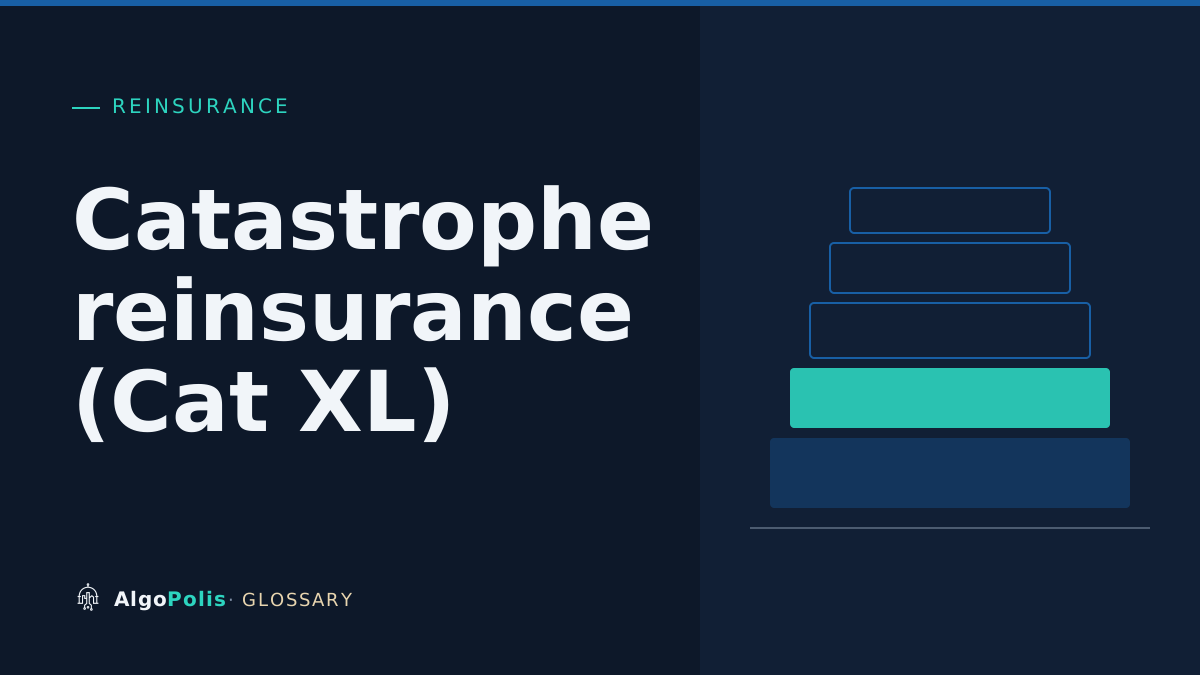
A French property insurer buys a windstorm Cat XL program structured in three layers: 50 million euros excess 50 million (working layer), 150 million excess 100 million and 250 million excess 250 million. Klaus, on January 24, 2009, costs the French market 1.5 billion euros in insured losses according to the FFSA. For this insurer, aggregate losses reach 180 million: the first 50 million are for its own account, the working layer is fully exhausted (50 million), and 80 million of the second layer is consumed.
- Howden, "The Great Realignment", 1 January 2023 renewal report; Guy Carpenter, property catastrophe Rate-on-Line indices at January 1, 2023 (Reinsurance News, January 2023); FFSA, insured cost of windstorm Klaus of January 24, 2009 (French Senate report on storm Klaus)
Follow the research
One letter a week. First, the week's underwriting note, when one is published: a dated, argued decision, signed by Paul Bernardski. Then what the observatory published on cyber risk, political risk and insurance. No account, no tracking.
No spam, one-click unsubscribe, no data ever sold.